Seared King Oyster Mushrooms with Molten Earth Espresso Rub
Pressed hard in cast iron until the crust goes dark and the finish turns long.
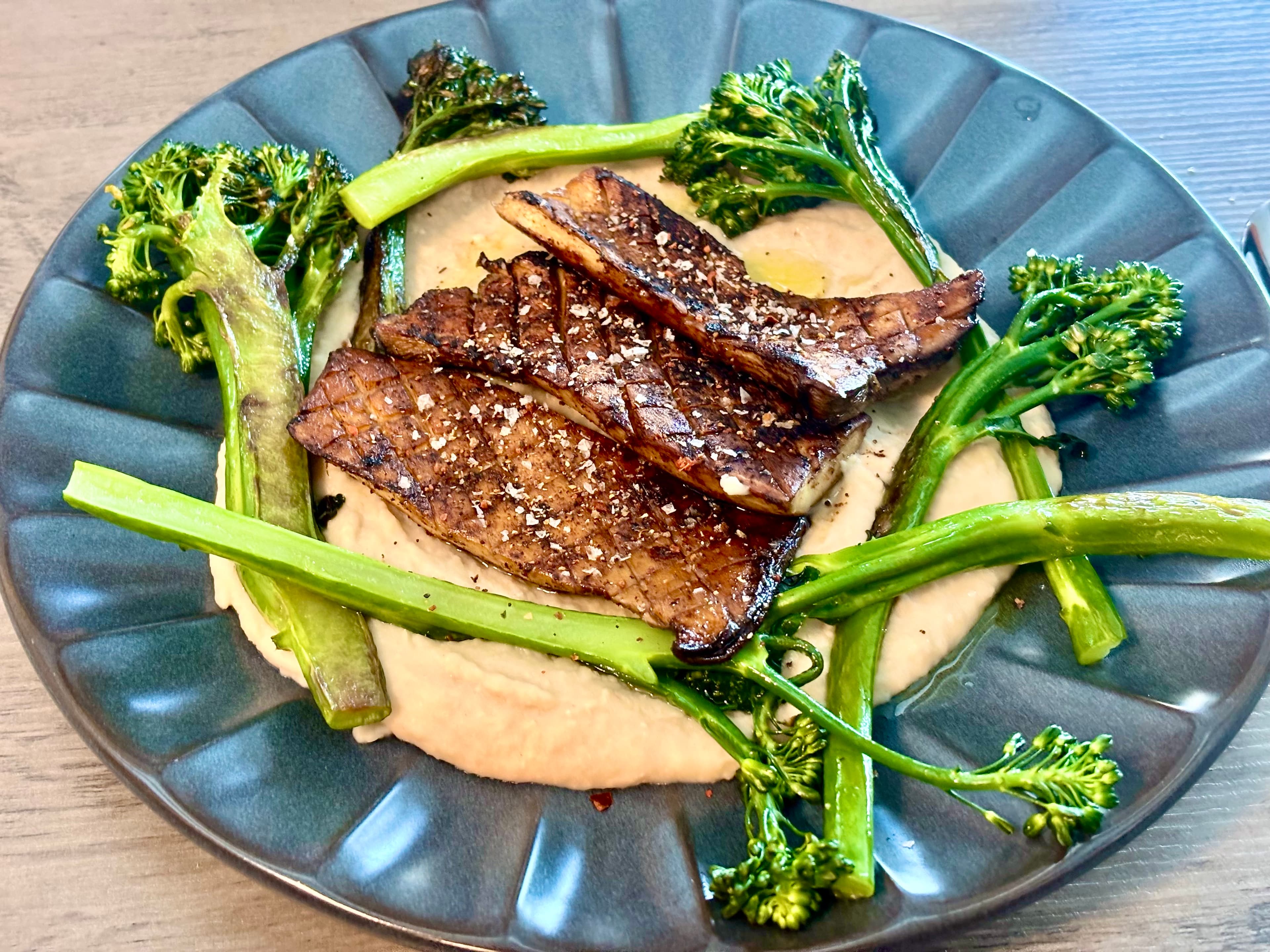
Thick king oyster halves scored, pressed in a hot skillet, and seasoned only once the cut face has already set. Molten Earth Espresso Rub builds a dark, savory crust on a vegetable that brings no fat of its own, so the timing of when the blend lands is the whole recipe. A plain white bean and slow-cooked garlic puree sits underneath and stays deliberately quiet, with Scarlet Citrus Fire Finishing Salt at the table for lift.
Ingredients, method, and practical notes
Equipment
Method
Combine 5 tablespoons olive oil and the sliced garlic in a small saucepan, starting cold. Set over low heat and cook 10 to 12 minutes, until the slices are pale gold and the oil smells sweet. Strain, keeping the oil and the garlic separately.
👁 Slices are pale gold with no brown edges. The oil is faintly yellow and smells sweet rather than sharp.WhyStarting in cold oil lets the garlic give up its flavor slowly instead of searing on contact. Low and slow turns it sweet; fast and hot turns it bitter.What to noticeThe aroma shifts from raw and sulfurous to soft and sweet somewhere around minute seven. That shift is the infusion working.If something's offThe slices go brown at the edges and the oil smells toasted rather than sweet.Fix: Pull the pan off the heat immediately and strain. Browned garlic will push the puree bitter, and this plate already carries bitterness from the espresso and cocoa in Molten Earth Espresso Rub.
Blend the drained beans, the cooked garlic, 3 tablespoons of the garlic oil, the lemon juice, and 3 to 4 tablespoons of the reserved bean liquid until completely smooth, about 90 seconds. Add the fine salt and stop while it still tastes slightly under-seasoned.
👁 The puree holds a soft ridge from a spoon and does not run back flat.WhyThe fat and the bean liquid together are what make this spread rather than crumble. Blending short leaves grain that reads as chalky under a crisp mushroom.What to noticeTaste for salt here and stop early. It should feel like it is missing something. That gap is where the finishing salt lands later.If something's offThe puree is stiff and pulls away from the blender walls in a mass.Fix: Add reserved bean liquid one tablespoon at a time with the motor running until it moves freely again.
Transfer the puree to a small saucepan over low heat and stir until it steams, 3 to 4 minutes. Cover and hold warm, or reheat briefly just before plating. Loosen with reserved bean liquid a spoonful at a time as it thickens.
👁 Steam rises when you stop stirring and the surface stays glossy rather than setting into a skin.WhyCanned beans blended with cool liquid come out barely above room temperature. A cold base under a hot mushroom pulls heat out of the crust within a minute of plating.What to noticeIt thickens noticeably as it warms. Judge it by how it spreads off the back of a spoon, not by how it looked in the blender.If something's offThe bottom catches and the puree tastes faintly scorched.Fix: Bean puree sticks fast. Keep the heat genuinely low and stir every 20 seconds. If it has caught, transfer to a clean pan without scraping the bottom.
Wipe the mushrooms with a dry cloth rather than rinsing them. Trim the dry stem base and halve each mushroom lengthwise through the cap. Score the flat cut face in a shallow cross-hatch about 1/8 inch deep and 1/4 inch apart, then brush both faces with 1 tablespoon olive oil.
👁 The cut faces look matte and dry before oiling, with no beads of water sitting in the scored lines.WhySurface water has to leave before browning can start, and a rinsed mushroom will steam in the pan for the first two minutes instead of searing. The scoring opens more surface for the crust to form on and stops the slab from curling as it firms.What to noticeThe flesh should feel dense and slightly springy under the knife, closer to a raw scallop than to a button mushroom.If something's offThe knife slides through with no resistance and the cut face looks wet.Fix: That mushroom is past its window and will release liquid instead of browning. Cook it separately as a saute rather than trying to press a crust onto it.
Heat a 12-inch cast iron skillet over high heat until a drop of water skitters. Add 1 tablespoon of the garlic oil and the broccolini in one layer. Leave it alone 2 minutes, toss once, and cook 2 minutes more. Season with a pinch of fine salt and move to a plate. Wipe the skillet.
👁 Blackened blisters along the stems and florets that have collapsed slightly but still stand up when lifted.WhyCooking the broccolini first means the mushrooms go into a skillet that has already proven it holds heat, and the broccolini itself is just as good ten minutes later.What to noticeIt should sound aggressive from the moment it lands. A quiet pan means the broccolini will soften before it chars.If something's offThe stems turn army green and go limp with no blistering.Fix: The pan was crowded or underheated. Work in two batches and give the skillet a full four minutes on high before the first one goes in.
Return the wiped skillet to high heat for 4 minutes, then add 1 tablespoon olive oil and swirl to coat.
👁 The oil thins immediately and moves like water when you tilt the pan.WhyThis is the single point where the recipe most often fails. Cast iron loses surface heat fast after the broccolini comes out, and a pan that is merely hot will cook the mushroom through before a crust forms.What to noticeHold a hand a few inches above the surface. The heat should be uncomfortable within two seconds.If something's offThe oil pools and moves sluggishly.Fix: Give it another two minutes. There is no recovering a pale crust later in the process.
Lay the mushrooms scored side down. Press with a smaller pan or a foil-wrapped brick and cook 4 to 5 minutes without moving them.
👁 The cut face is deep brown across the whole surface, not just at the scored lines, and looks set rather than damp.Cook-In PhaseWhyPressing forces flat contact across a surface that naturally domes. Without weight the crust forms only where the mushroom happens to touch the pan.What to noticeListen for a steady hard sizzle for the whole five minutes. If it goes quiet the pan has cooled and the crust has stopped forming.If something's offThe mushrooms are pale after five minutes and liquid has collected around them.Fix: Too many in the pan. Two mushrooms is the limit in a 12-inch skillet. Pour off the liquid, raise the heat, and finish them in two batches.
Flip the mushrooms. Drizzle 1 teaspoon olive oil around the edges of the pan, then dust the seared face with 1 teaspoon of the Molten Earth Espresso Rub. Cook 3 minutes on the second side.
👁 The blend darkens within seconds of landing and looks damp rather than dusty as it takes up the oil.Bloom PhaseWhyThis is the timing the whole recipe turns on. Molten Earth Espresso Rub applied to a dry cold mushroom at the start will scorch long before a crust forms, because there is no rendering fat to open it. Applied here, the surface is already set and there is hot oil to receive it.What to noticeThe aroma changes almost immediately from raw and dusty to roasted. That shift is the espresso and cocoa opening.If something's offThe blend stays powdery on the surface and never darkens.Fix: Not enough oil reached the face. Add another half teaspoon around the edge and tilt the pan so it runs under the mushroom.
Flip back onto the dusted face and press 60 to 90 seconds. Dust the top face with the remaining 1 teaspoon Molten Earth Espresso Rub, flip once more, and give it 45 seconds. Total contact between the blend and the hot pan stays under three minutes.
👁 Both faces are dark and look dry rather than wet or glossy.Cook-In PhaseWhyThe crust needs direct heat to set, but espresso and cocoa turn acrid past about three minutes of pan contact. Capping the window is what separates a dark crust from a burnt one.What to noticeThe surface goes from matte to slightly lacquered as the blend binds to the mushroom. Once it stops looking loose, it is done.If something's offA sharp, ashy smell rises off the pan and the crust looks black rather than dark brown.Fix: Pull the mushrooms now. The blend has gone past its window and further pan time only deepens the acrid edge.
Move the mushrooms to a board and rest 3 minutes before slicing.
👁 The crust stays dry to the touch and the surface stops steaming.Rest PhaseWhyThe finish changes during this window. Cinnamon rounds off the bitter edge and sumac spreads underneath, so the crust reads roasted rather than sharp. Sliced straight off the heat, the bitterness sits right at the front of the bite.What to noticeTaste a trimmed end at one minute and another at three. The bitterness moves back on the palate and the mineral finish stretches out.If something's offThe crust turns soft and the board is wet underneath.Fix: The mushrooms were held too long or covered. Rest them uncovered and no more than five minutes.
Spoon the warm puree onto warmed plates and spread it wide with the back of a spoon. Slice each mushroom half on a steep bias into three or four pieces and fan them across the puree so the crust stays visible. Lean the broccolini alongside. Finish each portion with a pinch of Scarlet Citrus Fire Finishing Salt directly on the mushroom, and serve the lemon wedges alongside.
👁 The dark cut faces sit above the puree rather than sinking into it, with visible flakes of finishing salt catching light on the crust.Finish PhaseWhyScarlet Citrus Fire Finishing Salt is built to express at full strength on contact and loses its edge the moment it dissolves. On the crust it lands as a bright crack against a long mineral finish. Stirred into the puree it disappears and reads only as salt.What to noticeThe first bite should open bright and citrusy, then settle into the roasted crust underneath. Two distinct arrivals, not one flavor.If something's offThe plate tastes salty before it tastes bright.Fix: The puree or the broccolini was seasoned to target earlier. Serve the remaining finishing salt at the table and let each person add it themselves.
What This Recipe Teaches
That a blend's correct entry point is set by the surface it lands on, not by the step number, and that a vegetable with no fat of its own moves that entry point later than a piece of meat would.
How the Blend Behaves Here
On beef or lamb, Molten Earth Espresso Rub goes on before the pan because rendering fat opens it as the crust builds. A king oyster mushroom renders nothing, so the same early application puts espresso and cocoa on a dry surface over high heat and they scorch before browning starts. Applied after the first side has already set, with a teaspoon of oil drizzled in to meet it, the blend opens in about ten seconds and binds to a surface that is dry but not raw. Contact stays under three minutes because bitterness climbs past that point. During the rest, cinnamon rounds the bitter edge and sumac spreads underneath, which is when the finish stretches from sharp into long and mineral.
What to Notice
Aromatic entry: Roasted and dry, closer to a hot grill than to coffee. The espresso reads as char rather than as a cup of anything.
Mid-palate: Dense and savory, with soft fruited smoke from the ancho and a mushroom underneath that eats meaty rather than spongy. The white bean puree stays quiet and mostly registers as texture and warmth.
Lingering finish: Long and mineral, with no sweetness anywhere in it. The Scarlet Citrus Fire Finishing Salt cracks bright across the front of that finish and then clears, leaving the roasted character to fade on its own.
Early Application Against Mid-Sear Application
Why a blend built for fatty meat has to enter a lean vegetable later, and what scorching looks like as distinct from browning.
How: Cook four mushroom halves instead of two, in two batches, using the same 1 teaspoon of Molten Earth Espresso Rub per half. On the first batch, dust the scored face before it goes into the pan, the way you would season a steak. On the second batch, follow the recipe and apply the blend only after the first side has seared and the pan has been re-oiled. Keep the pan temperature, the press, and the total cook time identical.
Compare: Look at the crust before you taste it. The early-applied batch will read black and dusty at the scored lines where the blend caught dry heat, and the surface under it will be paler than it should be because the blend blocked contact between the mushroom and the pan. It tastes ashy at the front and the roasted character never arrives. The mid-sear batch has an even dark brown face that came off the mushroom itself, with the blend fused into it rather than layered on top.
Symptom: The cut face is pale and tan after a full five minutes of pressing, with liquid pooled in the pan
Cause: Either the skillet lost its heat after the broccolini came out, or three or more mushroom halves went in at once. Both drop the surface below the point where water leaves faster than it arrives, so the mushroom steams in its own liquid instead of browning.
Fix: Give the wiped skillet a full four minutes back on high before the mushrooms go in, and hold to two halves in a 12-inch pan. If liquid has already pooled, pour it off, raise the heat, and finish in batches.
Symptom: Bitterness builds through the bite and leaves an ashy edge
Cause: Dose or contact time, not technique. Two teaspoons across 12 ounces of mushroom is intentionally under a barbecue rub dose, and the blend has a three-minute window against a hot pan before espresso and cocoa turn acrid.
Fix: Do not increase the blend because the mushrooms look bare after the first dusting. Track the pan contact from the moment the first teaspoon lands and pull the mushrooms at three minutes regardless of how the crust looks.
Symptom: The crust softens between the pan and the plate
Cause: The mushrooms were covered during the rest, or rested longer than about five minutes, so steam coming off the interior collected against the surface.
Fix: Rest uncovered on a board and hold to three minutes. If you need a longer window, rest on a wire rack so air reaches the underside.
Symptom: The plate tastes salty before it tastes bright
Cause: The puree and the broccolini were seasoned to where they tasted finished on their own. Molten Earth Espresso Rub carries 12 percent salt and Scarlet Citrus Fire Finishing Salt carries 59 percent, so those two are contributing well over a gram of salt before the components are counted.
Fix: Season the puree and the broccolini to roughly 80 percent of where they feel right and let the finishing salt close the gap at the plate. If it has already happened, hold the finishing salt back and pass it at the table.
Notes
What Holds and What Does Not
The garlic oil and the puree can both be made a day ahead. The puree thickens as it chills, so hold back a tablespoon or two of bean liquid to loosen it on reheating. The mushrooms can be wiped, halved, and scored a day ahead and stored cut side up and uncovered, since a drier surface sears faster, but oil them only on the day. The broccolini can be charred up to an hour before serving and left at room temperature. The mushrooms themselves cannot be held. A seared mushroom goes soft within about 20 minutes as interior moisture works out to the surface. From cold pan to plate is roughly 12 minutes, which is a workable window to leave a guest alone.
Holding the Puree Safely
Cooked beans held in garlic oil are a poor candidate for sitting out. If the puree is made more than two hours before service, cool it in a shallow container rather than in the pot, since a deep mass cools slowly from the center, then cover and refrigerate. The same applies to leftover garlic oil, which keeps about a week refrigerated and should not be stored at room temperature.
Salt Across the Whole Plate
Two teaspoons of Molten Earth Espresso Rub is 5 g of blend at 12 percent salt, and a half teaspoon of Scarlet Citrus Fire Finishing Salt is about 1.25 g at 59 percent. Those two contribute roughly 1.3 g of salt before the puree, the broccolini, or the bean liquid are counted. Season every other component under target and let the finish close it.
Other Vegetables for the Sear
Portobello caps work with the same method but release more liquid, so press harder and expect to pour the pan off once. Cauliflower steaks cut 1 inch thick also take the crust well and need about 6 minutes on the first side rather than 5. Avoid thin or high-moisture mushrooms, which collapse before the crust sets.
Let One Blend Own the Plate
The puree is intentionally plain. Amber Root Base Blend underneath it would put turmeric and cardamom against espresso and ancho and both would lose. If you want a second Emberloft element on the table, keep it in the same lane as the finish rather than the crust.
More recipes like this
New recipes and seasonal cooking ideas, once a week. Never more.
See everything that's in the newsletter