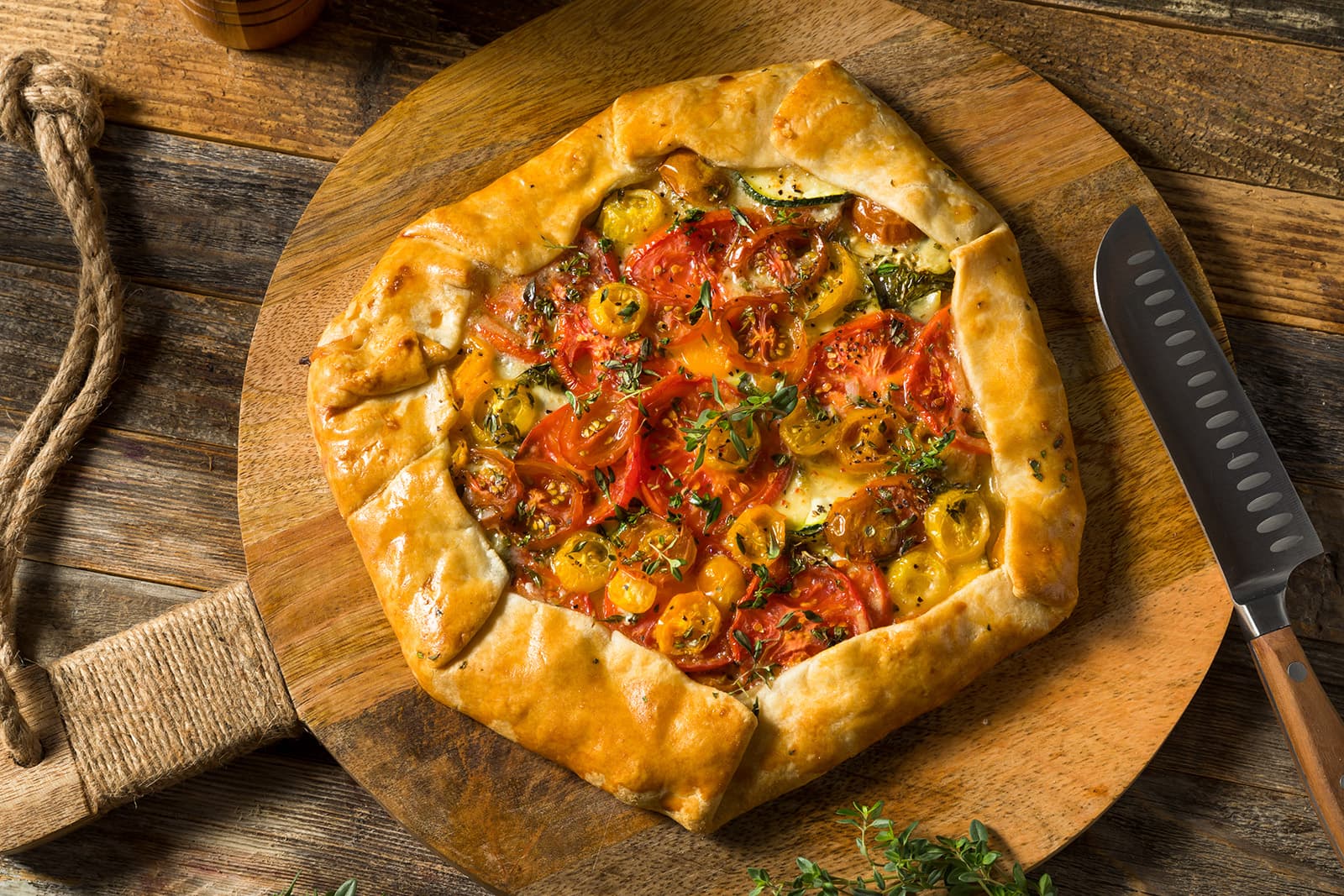
Spring Vegetable Galette with Silken Garden Green Blend and Goat Cheese
Rustic crust, herbed goat cheese that forgot it was tangy, and a salad that finishes the whole thing.
A free-form galette built on goat cheese blended with Silken Garden Green Blend until the tang softens into something savory and round. Spring vegetables bake on top. A peppery arugula salad with lemon and toasted walnuts goes on last, while the crust is still warm. The blend does not season the galette. It transforms the cheese from a sharp, assertive voice into a grounded, composed one.
Ingredients, method, and practical notes
Equipment
Method
Preheat the oven to 400°F. Line a baking sheet with parchment paper.
Toast the walnuts in a small dry skillet over medium heat for 3 to 4 minutes, shaking the pan occasionally, until fragrant and lightly golden. Transfer to a cutting board, chop roughly, and set aside.
👁 The walnuts smell toasty and sweet. A few dark spots are fine. No burning.WhyToasting deepens the walnuts' flavor and ensures they stay crunchy when they meet the warm galette. Raw walnuts would taste flat and slightly bitter.If something's offThe walnuts smell acrid or have turned dark brown throughout.Fix: The heat was too high. Transfer immediately and use them anyway if only slightly over-toasted. If truly burnt, start with a new batch at lower heat.
In a medium bowl, combine the goat cheese, one tablespoon of Silken Garden Green Blend, and one tablespoon of olive oil. Stir and press with a fork until the mixture is smooth, spreadable, and evenly green-flecked. There should be no white streaks of unblended cheese.
👁 A smooth, pale green, spreadable paste. The herbs are distributed evenly throughout, not clumped in spots.WhyThis is the most important step in the recipe. The blend must be thoroughly and evenly worked into the cheese so that every bite of the finished galette carries the same moderated flavor. Clumps of unblended cheese will bake sharp and tangy while the blended areas will taste savory and round, creating an uneven result that obscures the lesson.What to noticeTaste the cheese mixture now and remember what it tastes like. It will still have some tang, but the herbs should already be softening the sharp edge. After 35 minutes of baking, the tang will recede much further. That before-and-after comparison is the core of what this recipe teaches.If something's offThe cheese is cold and crumbly and will not blend smoothly.Fix: The cheese was not at room temperature. Microwave it in 10-second bursts, stirring between each, until it softens enough to stir. Or set it on the counter for 20 minutes. Cold cheese traps the herbs in pockets instead of distributing them.
In a separate bowl, toss the zucchini slices, leek half-moons, and halved cherry tomatoes with one tablespoon of olive oil and half a teaspoon of kosher salt. Mix gently until everything is lightly coated.
👁 The vegetables glisten lightly with oil. No pooling at the bottom of the bowl.WhyThe vegetables are seasoned simply with oil and salt, not with the blend. This is deliberate. The blend's job is to moderate the cheese. If it were also on the vegetables, the lesson would be diluted because you could not isolate what the blend is doing to the cheese versus what it is doing to the vegetables.Roll or unfold the dough into a rough circle, about 12 inches across, directly on the parchment-lined baking sheet. It does not need to be even or perfect. Rustic edges are the point.
👁 A roughly circular shape with natural, uneven edges. About 12 inches at its widest.Spread the herbed goat cheese mixture evenly over the dough, leaving a 2-inch border all the way around. Use the back of a spoon or an offset spatula to create a thin, even layer. The cheese should cover the interior completely with no bare spots.
👁 A thin, even layer of green-flecked cheese covering the interior of the dough. The 2-inch border is clean.WhyAn even layer ensures every bite of the finished galette carries the same proportion of cheese. If the cheese pools in the center and thins at the edges, the center will taste cheesy and the edges will taste like dry crust. Even distribution is how you get the blend's moderating effect to be consistent across the entire galette.Arrange the vegetables loosely over the cheese layer. Scatter the leeks first, then layer the zucchini rounds and tomato halves on top. Do not press them down into the cheese. Leave small gaps for steam to escape.
👁 A colorful, loose arrangement with the cheese visible in gaps between vegetables.WhyPressing the vegetables into the cheese traps moisture underneath them, which prevents the cheese from browning slightly during baking. The small gaps let steam escape and allow the cheese to develop light color where it is exposed, which deepens the savory flavor.Fold the 2-inch border of dough up and over the edge of the filling, pleating as you go. Each pleat should overlap the previous one slightly. The center stays open.
👁 A rustic, folded border with overlapping pleats. The center of the galette is open, showing the vegetables and cheese.Brush the exposed dough border with the beaten egg wash. Cover the crust evenly but do not let egg wash pool in the pleats.
👁 The dough surface is evenly coated and slightly shiny.WhyThe egg wash produces a golden, glossy crust. Without it, the crust bakes pale and matte.Bake for 35 to 40 minutes until the crust is deeply golden brown and the cheese has melted into the vegetables with light browning visible where it is exposed. The tomatoes should be blistered and slightly collapsed.
👁 Deep golden crust. The cheese has melted and shows light golden-brown spots where exposed. Tomatoes are blistered. Zucchini is tender and slightly charred at the edges.Cook-In PhaseWhyThe 35 to 40 minutes of baking is where the blend completes its work. The herbs in the cheese cook into the dairy fat under sustained oven heat. The tang that was still faintly present in the raw mixture recedes as the coriander and celery leaf fully integrate. By the time the galette comes out, the cheese should taste savory and round, not sharp.What to noticeSmell the galette as it bakes. Around 20 minutes, the kitchen will smell like warm herbs and toasting butter. By 35 minutes, the aroma should be deeply savory, not tangy or sharp. If it still smells strongly of goat cheese at the end, the cheese was too cold when the blend was mixed in and the herbs did not distribute evenly.If something's offThe crust is pale and soft after 35 minutes.Fix: The oven temperature is too low, or the oven was not fully preheated. Continue baking in 5-minute increments until the crust is golden. If using a convection setting, reduce the temperature to 375°F.
Remove the galette from the oven and let it rest on the baking sheet for 10 minutes. Do not skip this step. The filling sets and the cheese firms slightly, making clean slices possible.
👁 The cheese has stopped bubbling and the filling looks set rather than liquid. The galette holds its shape when the baking sheet is tilted slightly.Rest PhaseWhyThe rest is functional, not cosmetic. The cheese needs to cool enough to set slightly, or it will run when you slice. The herb flavor also smooths out during these 10 minutes. Taste the filling right out of the oven and again after the rest: the rested version will be more composed and more savory.What to noticeIf you tasted the raw cheese mixture in step 3, compare it to a small bite of the baked, rested filling now. The tang should be substantially reduced. The cheese should taste savory, herby, and grounded. That transformation is the blend moderating the assertive element.While the galette rests, make the finishing salad. In a bowl, toss the arugula with one tablespoon of olive oil, two teaspoons of lemon juice, a pinch of flaky salt, and a crack of black pepper. Add the chopped toasted walnuts and toss once more. Pile the salad on top of the warm galette just before slicing and serving.
👁 A bright, loose mound of dressed arugula and walnut pieces sitting on top of the warm galette. The bottom leaves wilt slightly on contact with the warm filling. The top leaves stay crisp.Finish PhaseWhyThe salad solves three structural problems at once. The lemon juice provides the direct acid the galette needs to keep the rich cheese from feeling heavy. The raw arugula adds a peppery bite and a fresh, volatile aroma that the baked filling cannot deliver. The toasted walnuts add crunch against the soft cheese and tender vegetables. Without this salad, the galette is a warm, soft, rich thing with no counterpoint. With it, every bite has opposition: warm and cool, soft and crunchy, rich and bright.What to noticeTake one bite of galette without the salad and one with. Without: warm, savory, pleasant, but settling into richness quickly. With: the lemon lifts the cheese, the arugula adds a peppery edge, and the walnut gives your teeth something to do. The salad is not a garnish. It is the finish that makes the galette a complete dish.
What This Recipe Teaches
How the blend moderates an assertive ingredient (goat cheese) by grounding its tang into savoriness, demonstrating the Checks and Balances principle that every assertive element needs a moderating counterpart.
How the Blend Behaves Here
Silken Garden Green Blend is worked directly into room-temperature goat cheese before the galette is assembled. The coriander and celery leaf immediately begin softening the cheese's sharp tang, while the parsley, basil, dill, and mint add herby complexity. During 35 to 40 minutes of baking, the blend's herbs cook into the dairy fat and the moderating effect deepens. The tang that was still faintly present in the raw mixture recedes. By the time the galette comes out of the oven and rests for 10 minutes, the cheese tastes savory and grounded rather than sharp and assertive. The blend did not add herb flavor to goat cheese. It changed the cheese's character.
What to Notice
Aromatic entry: Warm, herby, toasted pastry. The first impression is savory and inviting, not cheesy or tangy.
Mid-palate: Creamy, grounded goat cheese carrying integrated herb flavor. The vegetables add sweetness (leeks, tomatoes) and a mild freshness (zucchini). The crust provides a buttery, flaky contrast.
Lingering finish: The arugula's peppery bite cuts through the richness. Lemon lifts the herbs. Walnuts leave a crunchy, slightly bitter note that reinforces the savory direction. The finish is clean and bright, not heavy.
The Moderated vs. Unmoderated Cheese Test
What happens when an assertive ingredient (goat cheese) has no moderating counterpart.
How: Make two small galettes using half the recipe each. For the first, mix the goat cheese with Silken Garden Green Blend as written. For the second, use the same amount of plain goat cheese with just salt and olive oil, no blend. Bake both identically. Taste a bite of each after resting.
Compare: The plain goat cheese galette will taste like a cheese tart: the tang dominates everything, the vegetables are an afterthought, and the cheese is the only voice you hear. The blended version will taste like a composed dish: the cheese is present but grounded, the vegetables register, and the overall flavor is savory rather than tangy. That difference is the Checks and Balances principle. The blend is the moderator. Without it, the assertive element has no counterpart and it takes over.
Symptom: The filling tastes sharply tangy, like plain goat cheese with herbs on top
Cause: The blend was not mixed thoroughly into the cheese, or the cheese was cold when blended. Cold cheese traps the herbs in pockets rather than distributing them evenly, and the undistributed portions bake without moderation.
Fix: Bring the goat cheese fully to room temperature before blending. Stir and press with a fork until the mixture is uniformly colored with no white streaks. Every bit of cheese must contact the herbs for the moderation to work.
Symptom: The galette tastes flat and lacks brightness despite the vegetables and cheese being well-seasoned
Cause: The finishing salad was omitted or the lemon juice was left out of the dressing. The baked filling is rich and savory, but without acid at the finish, it has no lift and begins to feel heavy.
Fix: The arugula salad with lemon is not optional garnish. It is the brightness mechanism for the entire dish. Make and apply the salad just before serving.
Symptom: The filling is liquid and runs when the galette is sliced
Cause: The galette was not rested long enough after baking. The cheese needs 10 minutes to set slightly as it cools.
Fix: Rest the full 10 minutes on the baking sheet. If the filling is still very loose, the cheese may have been too thin a layer. Use the full 6 oz next time and spread it evenly.
Symptom: The crust is soggy on the bottom where it contacts the cheese
Cause: The vegetables released too much moisture during baking, or the dough was not on parchment. Zucchini is the most common moisture culprit.
Fix: Slice the zucchini thinly (1/8 inch) and salt it lightly for 5 minutes, then blot dry with paper towels before arranging on the galette. This draws out excess moisture before baking. Always bake on parchment for even heat transfer.
Notes
Cheese Alternatives
Ricotta works but produces a milder, creamier result. The Checks and Balances lesson is less dramatic because ricotta is not as assertive as goat cheese. If using ricotta, drain it in a fine-mesh strainer for 30 minutes first to remove excess moisture. Cream cheese works structurally but lacks the tang that makes the moderation lesson visible.
Seasonal Vegetables
The vegetable layer is flexible. In summer, use sliced summer squash and fresh corn kernels. In fall, thinly sliced delicata squash and sauteed mushrooms. In winter, roasted beets and caramelized onions. The cheese-blend filling stays the same regardless of the vegetables on top.
Advance Preparation
The herbed cheese mixture can be made up to a day ahead and refrigerated. Bring it back to room temperature before spreading. The walnut-arugula salad should be assembled right before serving. The galette itself is best eaten within an hour of baking.
Dough Tips
If the dough tears while folding the border, pinch it back together and press firmly. The egg wash seals small cracks. If the dough feels warm and soft, slide the entire baking sheet into the refrigerator for 10 minutes before baking. Cold dough holds its shape better in the oven.
Serving and Portioning
Slice the galette on the baking sheet to avoid moving it while warm. A pizza wheel or large sharp knife works best. Serve with the salad already on top so each slice gets greens. This is a main course for 4 or a generous appetizer for 6.
More recipes like this
New recipes and seasonal cooking ideas, once a week. Never more.
See everything that's in the newsletter