Charred Cabbage with Lemon Yogurt, Toasted Almonds
Smoky, bitter, cool, and sharp, all resolved in a single bright pinch.
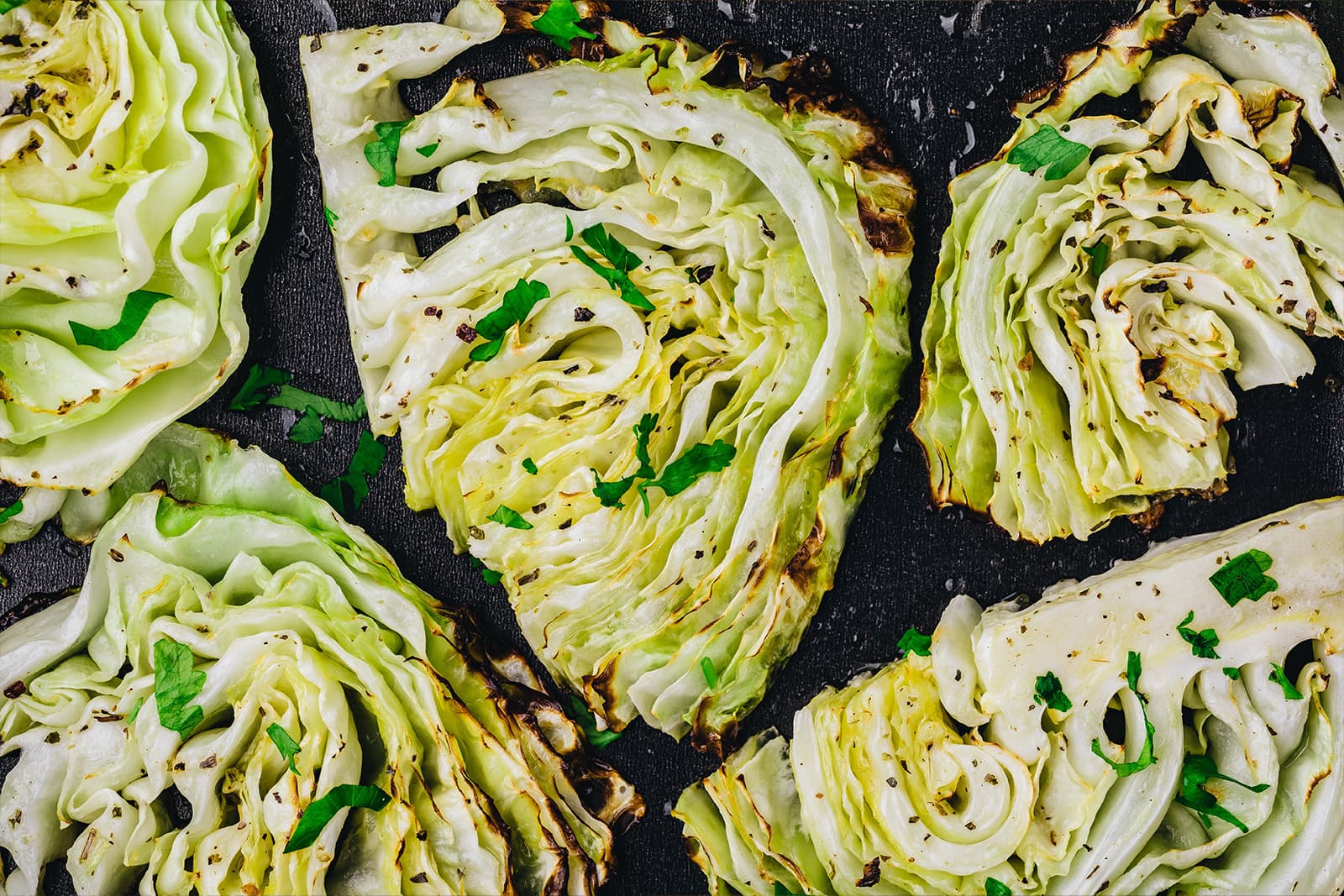
Wedges of cabbage charred until smoky and tender, set over lemon yogurt and scattered with toasted almonds (or other nuts). Scarlet Citrus Fire Finishing Salt lands last and ties every opposing element together. Without it, the plate is good. With it, the plate is finished.
Ingredients, method, and practical notes
Equipment
Method
Place a small dry pan over medium heat. After about 1 minute, hold your hand a few inches above the surface. You should feel steady warmth.
Add the chopped nuts in a single layer. Stir or shake the pan every 20 to 30 seconds, keeping the nuts moving. Toast for 3 to 5 minutes until they smell fragrant and turn lightly golden in spots. Remove from the pan immediately and transfer to a plate to cool.
👁 Light golden color in spots and a warm, toasted aroma. No dark brown or burnt patches.WhyToasting deepens the nuts' flavor and makes them more fragrant. Transferring them to a plate stops the cooking. Left in the hot pan, they will continue to darken and turn bitter.What to noticeThe smell shifts from raw and starchy to warm and toasted. That shift is the signal. Color follows smell by about 30 seconds, so pull them when the aroma is right rather than waiting for perfect color.If something's offDark brown patches or a sharp, acrid smell.Fix: Heat was too high or they sat too long without stirring. Start over with fresh nuts at a lower temperature. Burnt nuts taste bitter and will fight the finishing salt's brightness.
In a small bowl, stir the yogurt with 1 teaspoon of the lemon juice and a pinch of salt. Taste. Add the remaining half-teaspoon of lemon juice only if the yogurt needs more brightness. The yogurt should taste gently bright, not sour or sharp. Set aside at room temperature.
👁 Smooth and creamy with no lumps. A clean, mild tang when tasted.WhyThe yogurt provides a cool, rich base for the charred cabbage. If it is too sour, it competes with the finishing salt's citrus instead of letting the salt be the bright top note.What to noticeTaste it on its own. It should feel calm and slightly tangy, like a supporting player, not a lead. If it tastes sharp, you have added too much lemon.If something's offThe yogurt tastes distinctly sour or makes your mouth pucker.Fix: Add another tablespoon of yogurt and a small pinch of salt to push the acid back into the background.
Heat a large, heavy pan (cast iron is ideal) or grill pan over medium-high heat for 3 to 4 minutes. You should feel strong heat when holding your hand a few inches above the surface.
👁 A drop of water flicked onto the surface evaporates within a second or two.WhyA very hot pan is essential. Char happens through direct, intense contact between the cabbage surface and the metal. A warm pan will steam the cabbage instead of browning it.Brush the cabbage wedges on both cut sides with 2 tablespoons of olive oil. Sprinkle with kosher salt.
👁 A thin, even sheen of oil on both flat sides. No pooling or dripping.WhyOil conducts heat into the cabbage surface. Too much oil and the cabbage will fry rather than char. Too little and it will scorch and stick.Place the cabbage wedges cut-side down in the hot pan. Do not crowd them. Work in batches if needed, leaving at least an inch between wedges. Cook 4 to 6 minutes on the first side without moving them, until deeply browned and charred at the edges.
👁 Dark brown to black char marks where the cabbage touches the pan. The edges darken and crisp. The center softens slightly.WhyCharring creates the smoky bitterness that defines this dish. Moving the wedges interrupts contact with the hot surface and prevents even browning. Crowding traps steam and turns charring into steaming.What to noticeListen for a steady sizzle. If it goes quiet, the pan has cooled from crowding. You should smell something between toasted and slightly smoky, not acrid.If something's offThe cabbage is blackened unevenly with raw white patches, or the sizzle stopped and moisture is pooling around the wedges.Fix: If the pan cooled, remove the cabbage, let the pan recover for 2 minutes, and continue. If blackening happened too fast, lower heat to medium for the second side.
Flip each wedge carefully with tongs. If the pan began to smoke heavily or the cabbage blackened too fast, lower the heat to medium. Cook the second side for 3 to 5 minutes until charred and tender. The leaves should yield when pressed gently with tongs but not collapse.
👁 Both sides deeply browned. The outer leaves are charred and slightly crisp. The inner layers are softened but still hold their shape.WhyThe second side needs slightly less time because the cabbage is already warm through. Overcooking turns the wedges into mush and loses the structural contrast between charred exterior and tender interior.If something's offThe wedges fall apart when flipped or pressed. The leaves are limp and translucent throughout.Fix: The cabbage cooked too long on the first side. Next time, reduce the first-side time by 1 to 2 minutes. The center should be softened, not collapsed.
Transfer the charred cabbage to a plate and let it rest for 3 to 5 minutes.
👁 After resting, the char flavor has settled and the bitterness has softened slightly. The wedges hold their shape but feel tender throughout.Rest PhaseWhyResting does two things. It allows residual heat to finish softening the center, and it steadies the bitter, smoky flavor. Cabbage served immediately off a very hot pan can taste aggressively charred. After a few minutes, the bitterness rounds out.What to noticeIf you taste a small piece immediately off the pan and compare it to a piece after 4 minutes, the rested piece will taste smoky and warm rather than sharp and bitter. The difference matters for how the plate comes together.Spread the lemon yogurt in a thick, even layer across a serving plate using the back of a spoon. Create a slight well in the center where the cabbage will sit.
👁 A smooth, generous layer of yogurt covering most of the plate. Not a thin smear.WhyThe yogurt is a foundation, not a drizzle. Every bite of cabbage should be able to pick up yogurt. A thin layer disappears after the first wedge.Place the warm cabbage wedges on top of the yogurt. If using arugula or watercress, tuck small handfuls around and between the wedges so the greens sit against the warm cabbage and begin to wilt slightly.
👁 Dark charred wedges against white yogurt with bright green leaves tucked in the gaps, just beginning to soften where they touch the warm cabbage.WhyThe greens add a peppery, raw dimension that sharpens the contrast on the plate. Tucking them against the warm cabbage wilts them just enough to take the raw edge off without losing their bite.Scatter the toasted nuts evenly over the cabbage and greens.
Drizzle the remaining 1 tablespoon of olive oil over the entire plate. Then finish with one-quarter teaspoon of Scarlet Citrus Fire Finishing Salt, sprinkled from a few inches above so the flakes land gently and unevenly across the surface. Taste one bite before deciding if you want more.
👁 Flakes of red-orange salt visible against the dark cabbage and white yogurt. A faint citrus aroma lifts the moment the salt contacts the warm surface.Finish PhaseWhyThe olive oil drizzle before the salt is deliberate. Fat softens the Aleppo chile heat slightly and helps the citrus compounds spread across the plate rather than concentrating in one spot. Sprinkling from height distributes the salt unevenly, which means each bite is slightly different. Some will be more citrus-forward, others more smoky. That variation keeps the plate interesting across multiple bites.What to noticeThe moment the salt lands on the warm cabbage, a brief citrus aroma lifts. That is the citrus peel and sumac releasing on contact with the warm surface. On the cooler yogurt, the salt sits intact and expresses more slowly as you chew. Two different behaviors from the same pinch, depending on what it lands on.If something's offThe salt dissolved into the oil or yogurt and lost its flaky texture. Or the entire plate tastes uniformly salty rather than having bright, varied bursts.Fix: Sprinkle from higher up and use less. The salt should land as visible flakes, not dissolve on contact. If using more than one-quarter teaspoon for four servings, the salt will overpower the other elements.
What This Recipe Teaches
How a finishing salt resolves opposition between bitter, cool, and rich elements, turning separate components into a composed plate with a single pinch.
How the Blend Behaves Here
Scarlet Citrus Fire Finishing Salt behaves differently depending on what it lands on. On the warm charred cabbage, the citrus and spice aromas release quickly, creating an immediate bright aroma and a flash of clean heat that fades fast. On the cool yogurt, the salt sits intact longer and expresses more gradually as you chew, delivering a slower, more sustained citrus note. The olive oil drizzle underneath carries the heat across the palate rather than letting it concentrate in one spot. The result is a finish that feels composed rather than sharp.
What to Notice
Aromatic entry: Smoky char from the cabbage and warm toasted nuts rising before the fork reaches your mouth. If the salt is on a warm piece, a faint citrus note lifts alongside the smoke.
Mid-palate: Cool, tangy yogurt meets warm, bitter cabbage. The nut crunch breaks through. If greens are present, a peppery bite sharpens the middle of the experience.
Lingering finish: A brief, clean flash of citrus heat from the finishing salt, then it fades. Sumac's dry tartness lingers a moment longer than the chile heat, keeping the finish bright rather than heavy. The final impression is smoky-bright, not smoky-rich.
The Oil-Before-Salt Test
How fat changes the way a finishing salt's heat and citrus express on food.
How: Plate two small portions of the assembled dish. On one, apply Scarlet Citrus Fire Finishing Salt directly to the warm cabbage with no oil drizzle. On the other, drizzle olive oil first, then apply the same amount of salt on top of the oil. Taste both within 30 seconds.
Compare: The no-oil version will taste brighter and more immediate. The heat will feel sharper and more localized. The oil version will feel rounder. The heat softens and the citrus spreads more evenly. Neither is wrong. The choice depends on whether you want the salt to punctuate or blend.
Symptom: The cabbage tastes aggressively bitter and acrid rather than pleasantly smoky
Cause: The cabbage was charred too hard, too fast, or too close to a direct flame. Char should be dark brown to black at the edges, not uniformly black across the surface.
Fix: Lower the heat to medium-high rather than high. Char should develop over 4 to 6 minutes, not in the first 2. If the cabbage is already too bitter, the yogurt and finishing salt will help, but next time aim for color that is deep brown with black spots, not solid black.
Symptom: The plate tastes like separate ingredients rather than a composed dish
Cause: The finishing salt was left off, applied too sparingly, or the olive oil drizzle was skipped. Without the salt and oil, nothing bridges the smoky cabbage and the cool yogurt.
Fix: Add the salt. It is doing structural work, not decoration. The oil drizzle helps carry the salt's citrus across the plate. Both together are what resolve the opposition between the components.
Symptom: The finishing salt overwhelms everything and the plate tastes only of citrus and heat
Cause: Too much Scarlet Citrus Fire Finishing Salt. A quarter teaspoon for four servings is the starting point. The salt is concentrated and potent.
Fix: Taste before adding more. The goal is a bright punctuation, not a second seasoning layer. If you have already over-applied, add more yogurt to the plate to absorb and dilute the salt's impact.
Symptom: The yogurt tastes sharp and sour, competing with the finishing salt's citrus
Cause: Too much lemon juice in the yogurt. The yogurt should be gently tangy, not distinctly sour. If both the yogurt and the finishing salt taste citrusy, the plate loses its contrast.
Fix: Start with 1 teaspoon of lemon juice and taste before adding the rest. The yogurt's job is to cool and round, not to be a second acid source.
Notes
Cabbage Varieties
Green cabbage chars well and holds its structure. Savoy has more tender leaves and chars faster, so reduce the cooking time by 1 to 2 minutes per side. Red cabbage works but turns dark and loses visual contrast against the char. Napa cabbage is too delicate for this method.
Grilling Instead of Pan-Charring
This recipe works on an outdoor grill over medium-high direct heat. Oil and season the wedges the same way. Grill 3 to 4 minutes per side with the lid off. The char will be more uneven and smoky, which is desirable. The finishing salt behaves the same way on grilled cabbage.
Advance Preparation
The yogurt can be mixed up to a day ahead and refrigerated. The nuts can be toasted up to 3 days ahead and stored at room temperature in a sealed container. The cabbage should be charred fresh. Do not apply the finishing salt until the moment of serving.
Scaling for a Crowd
This plates well on a large platter for family-style serving. Spread the yogurt across the whole platter, arrange all the wedges, and let guests apply their own finishing salt from a small dish on the side. This preserves the flaky texture and lets each person control the amount.
More recipes like this
New recipes and seasonal cooking ideas, once a week. Never more.
See everything that's in the newsletter