Crimson Ember Skirt Steak with Charred Lime and Quick-Pickled Onion
A hard sear, a short rest, and a crust that tells you everything about how thin cuts change the rules.
Skirt steak rubbed with Crimson Ember and seared fast in a screaming-hot pan. The thin cut forms a dark, savory crust in under three minutes per side, and the compressed rest lets sumac surface sooner than you expect. Charred lime and quick-pickled red onion turn every slice into opposition: dark against bright, char against snap, warm smoke against sharp acid.
Ingredients, method, and practical notes
Equipment
Method
Make the quick pickle first. In a medium bowl, stir together the red wine vinegar, warm water, sugar, and salt until the sugar dissolves. Add the sliced red onion and press the slices down so they are submerged. Set aside at room temperature for at least 15 minutes while you prepare the steak. The onions will turn bright pink.
👁 The onion slices soften slightly and turn from purple to vivid pink. The brine takes on color.WhyThe pickle needs at least 15 minutes to soften the onion's raw sulfur bite while preserving its crunch. Starting this first means it is ready when the steak is. Warm water dissolves the sugar and salt faster and opens the onion's structure to absorb the brine.What to noticeTaste a ring at 10 minutes and again at 15. At 10 minutes, there is still a raw bite underneath the vinegar. At 15, the sharpness has softened into clean, bright acidity with crunch.Pat the skirt steak sections completely dry with paper towels on both sides. Season all surfaces with kosher salt and Crimson Ember, pressing the rub firmly into the grain with your hands. Let sit at room temperature for 10 minutes.
👁 The rub adheres in an even, dark red-brown coating. After 10 minutes, the surface looks slightly damp where salt has drawn a thin sheen of moisture that the rub has absorbed.WhySkirt steak's open grain pulls the rub deeper than a tight-grained cut would. The 10-minute rest lets salt begin seasoning the meat and allows the surface to develop the tacky texture that promotes crust adhesion. Longer than 10 minutes risks drawing too much moisture and making the surface wet, which fights against browning.What to noticePress a finger gently into the surface after 10 minutes. It should feel tacky, not wet. If moisture is pooling visibly, blot once more before cooking.If something's offThe rub is sitting in loose patches or falling off the surface.Fix: The meat was not dry enough before seasoning. Blot again, then press the rub into the oiled surface. On very wet meat, drizzle a thin film of oil over the steak first, then apply the rub into the oil.
Heat a 12-inch cast iron skillet over high heat for 3 full minutes. The pan must be genuinely hot before oil goes in.
👁 Hold your hand 3 inches above the pan surface. You should feel strong, radiating heat within 2 seconds. A drop of water flicked onto the surface evaporates instantly with a sharp hiss.Bloom PhaseWhySkirt steak is thin. You need violent heat to form a crust before the interior overcooks. A pan that is not fully preheated will steam the meat gray instead of searing it dark. Cast iron holds the temperature when cold meat hits it, which thinner pans cannot do.Add the neutral oil and swirl to coat the pan. Wait 10 to 15 seconds until the oil shimmers and the first wisps of smoke appear. Lay the steak sections into the pan, leaving at least one inch between each piece. Do not move them. If all pieces do not fit with space between them, sear in two batches.
👁 Oil shimmering with light smoke. The moment the steak hits the pan, a loud, aggressive sizzle fills the kitchen.Bloom PhaseWhyThe oil bridges contact between the rub and the hot metal. The aggressive initial sizzle confirms the pan is hot enough for the spices to bloom into the fat immediately. Crowding drops the pan temperature and produces steam instead of char.What to noticeListen. The sizzle should be hard, steady, and continuous from the moment the meat lands. If it goes quiet within the first 30 seconds, the pan was not hot enough or the pieces were too close together.If something's offLiquid pools around the steak. The sizzle dies down to a gentle bubbling. The surface looks gray and wet rather than beginning to darken.Fix: Remove the steak. Let the pan recover over high heat for 2 full minutes. Sear in smaller batches. A crowded pan is the most common cause of a gray, crustless skirt steak.
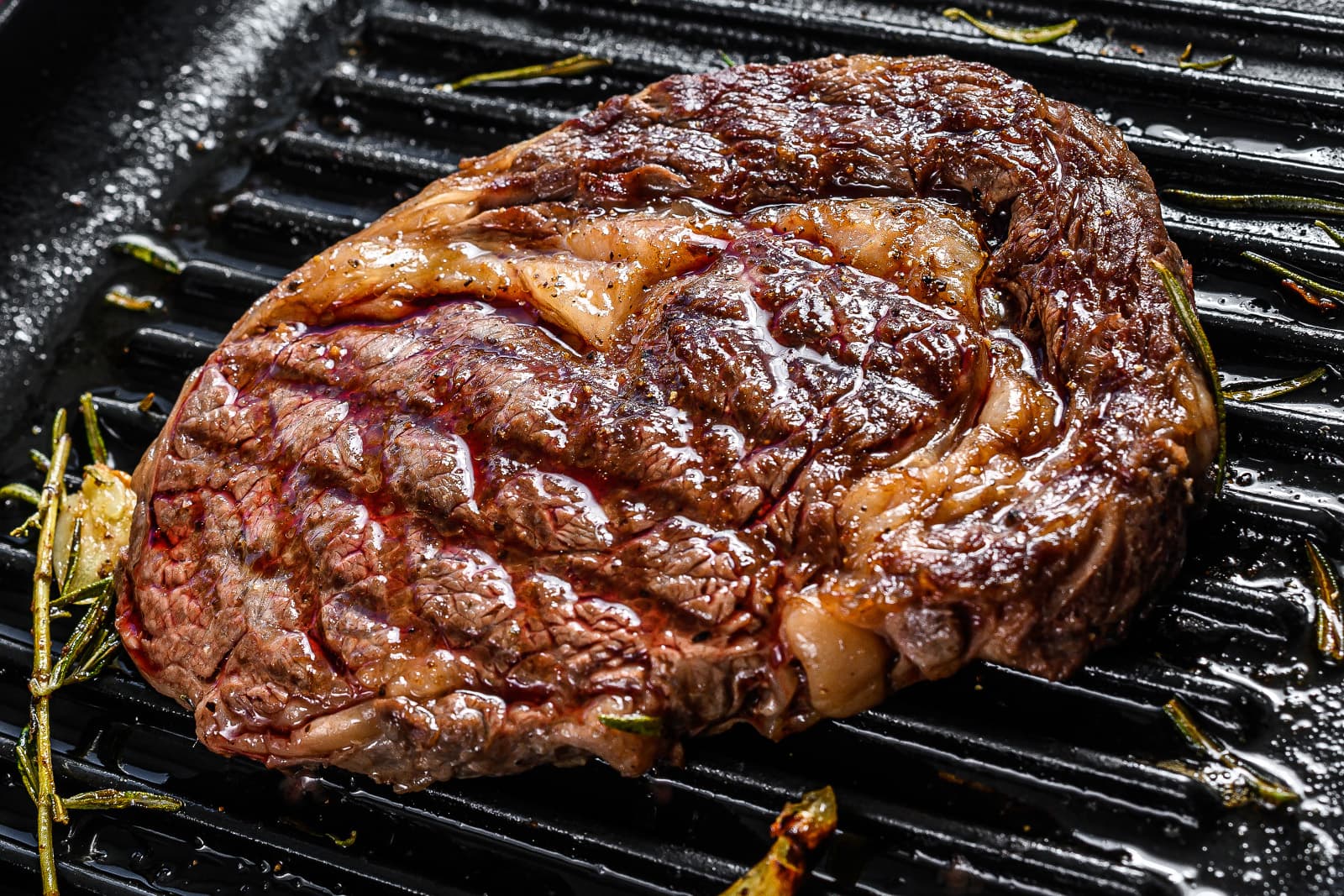
Sear the first side for 2 to 3 minutes without moving the steak. Check the underside by lifting one edge with tongs. You are looking for a dark, mahogany-red crust with no gray patches.
👁 Dark red-brown to mahogany crust across the entire contact surface. The edges of the steak show color rising about a third of the way up the sides.Bloom PhaseWhyCrimson Ember's cumin and smoked paprika darken and deepen during these 2 to 3 minutes of uninterrupted contact. Moving the steak breaks the crust as it forms. The rub has no sugar, so it will not burn at these temperatures the way a sweet rub would. Trust the heat.What to noticeThe kitchen should smell like toasted cumin and warm smoke by the 90-second mark. That aroma is the bloom happening in real time. If you smell scorching or bitterness instead, the heat is too high.If something's offThe crust is black and smells acrid rather than deep red-brown and toasty.Fix: Reduce heat slightly. Crimson Ember tolerates very high heat, but direct flame wrapping around the sides of the skillet on a gas stove can scorch the edges. Shift the skillet so the flame stays directly underneath.
Flip the steak and sear the second side for 2 minutes. For skirt steak, this should produce medium-rare to medium at the center. If your steak is unusually thick (over 1 inch), add 30 seconds.
👁 Both sides have a continuous, dark crust. When pressed gently with tongs, the steak gives with slight resistance but is not stiff.Cook-In PhaseWhyThe second side needs less time because both the pan and the meat are hotter. Skirt steak is thin enough that an extra 30 seconds can take it from medium-rare to well-done. Speed matters here more than on any thick cut.What to noticeSmall beads of juice may appear on the top surface near the end of the second side. This means the interior is contracting and pushing moisture outward. When you see this, the steak is at or near medium-rare. Remove it promptly.If something's offThe steak is stiff and does not yield when pressed. Juices run gray rather than pink.Fix: The steak went too long. On the next attempt, set a timer for 90 seconds on the second side and check. Skirt steak forgives under-cooking better than over-cooking because it can always go back in the pan for 15 seconds.
While the steak sears on its second side, place the lime halves cut-side down into any open space in the skillet, pressing them gently into the hot surface. Let them char for 60 to 90 seconds without moving. Remove and set aside.
👁 The cut surface of the lime is dark brown to black in spots. The edges of the lime flesh are caramelized and sticky.WhyCharring caramelizes the sugars in the lime juice and softens the raw acidity. The result tastes rounder and slightly smoky, which bridges the flavor gap between the dark, savory crust and the bright pickled onion. A raw lime squeeze would cut against the rub. A charred lime connects to it.What to noticeSqueeze a charred half into a spoon and taste. Compare it to juice from a raw half. The charred version is warmer, slightly sweet, and less sharp. That warmth is what makes it work alongside the rub instead of fighting it.If something's offThe lime tastes bitter and ashy rather than warm and caramelized.Fix: The lime sat too long or the pan was too hot in that spot. 60 to 90 seconds is enough. The flesh should char, but the juice should not evaporate completely.
Transfer the steak sections to a cutting board. Rest for 3 minutes. Do not cover, do not tent with foil, and do not cut.
👁 After 3 minutes, the steak looks relaxed rather than taut. A small amount of juice collects on the board, but the meat holds most of its moisture when cut.Rest PhaseWhyThis is where skirt steak teaches something a thick chop cannot. On a thin cut, heat exits fast. The rest-phase transformation that takes 8 minutes on a lamb chop happens in 3 minutes here because the steak reaches equilibrium sooner. The sumac in Crimson Ember begins expressing during this short window, shifting the crust from forward and sharp to dry, tart, and composed. Tenting traps steam and softens the crust you worked to build.What to noticeIf you can, slice a small piece immediately off the heat and taste it. Then taste a slice after the full 3 minutes. The immediate slice will taste smoky and sharp, with cumin and paprika dominating. The rested slice will have a dry brightness at the back of each bite. That is the sumac arriving. On thin cuts, this happens faster but the shift is just as real.If something's offAfter rest, the crust is soft and damp rather than intact.Fix: The steak was covered during rest, trapping steam. Always rest uncovered. If your cutting board pools liquid heavily, rest the steak on a wire rack set over a plate.
Slice the steak against the grain into strips about a quarter-inch thick. Skirt steak's grain runs the long way across each section, so your knife cuts crosswise, making short strips rather than long ribbons.
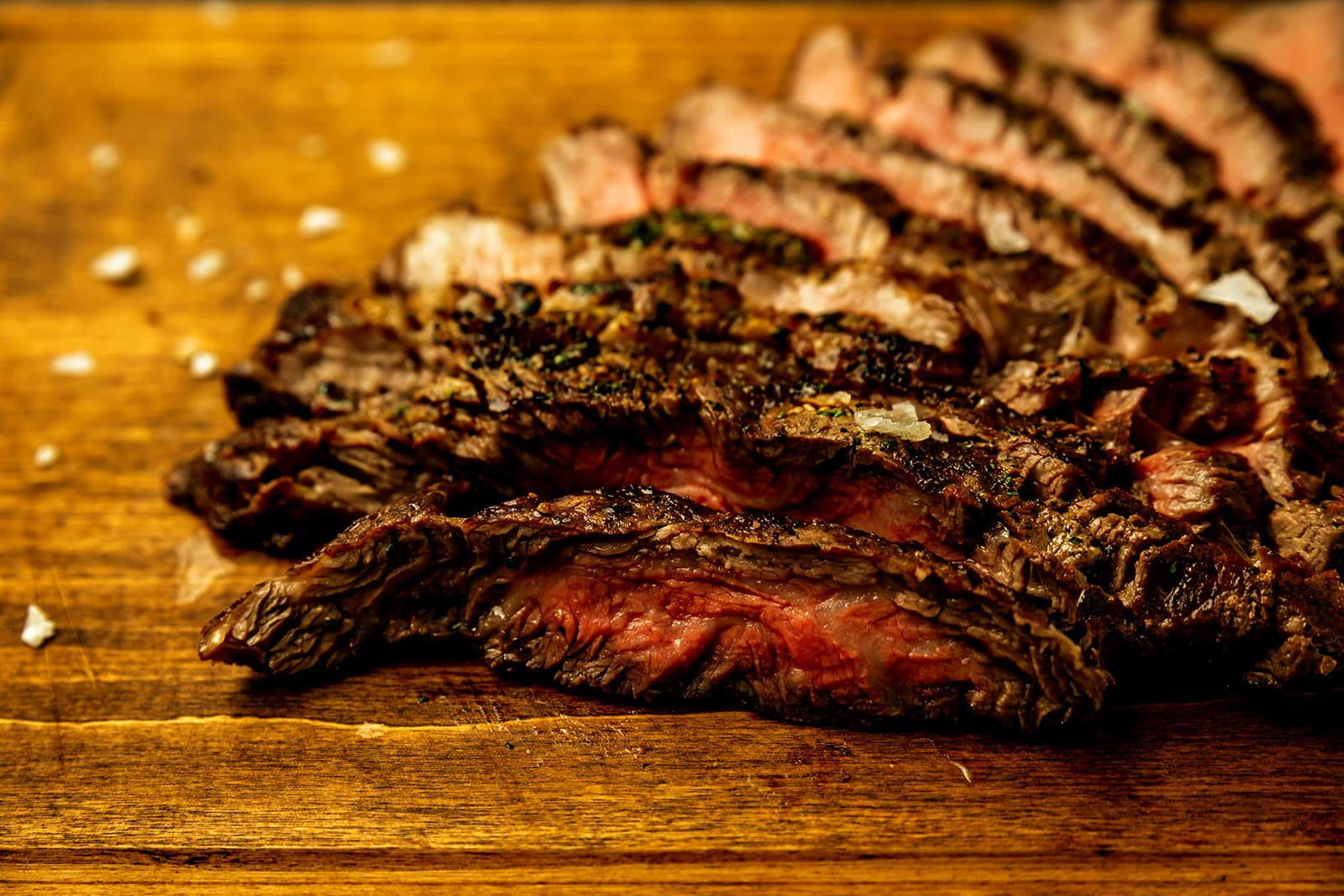
👁 Each slice shows a dark, intact crust on both faces with a pink interior. The grain separates easily when pulled. If the slices are chewy and long-fibered, you are cutting with the grain instead of against it.WhyCutting against the grain shortens the muscle fibers. This is especially important on skirt steak, which has a pronounced, loose grain. Sliced correctly, it is tender and pulls apart easily. Sliced with the grain, it becomes chewy regardless of how well it was cooked.What to noticeLook at the surface of the raw steak before cooking. The grain lines run lengthwise. Your knife should cross those lines at a right angle, producing slices 2 to 3 inches wide.If something's offSlices are long, stringy, and require effort to chew.Fix: You cut with the grain. Rotate the steak 90 degrees and re-slice. Even after an incorrect first cut, re-slicing against the grain improves the texture.
Arrange the sliced steak on a serving platter or individual plates. Drain the pickled red onion and scatter it generously over the meat. Squeeze the charred lime halves over the top. Tear the cilantro leaves and tender stems and drop them across the plate. If using Scarlet Citrus Fire Finishing Salt, pinch it lightly over the exposed interior slices, not the crust.
👁 Dark crust slices with pink interiors, bright pink pickled onion scattered across, green herbs, and visible lime juice glistening on the surface. The plate should look vivid, not monochrome.Finish PhaseWhyEvery element on this plate has a job. The pickled onion provides acid snap and textural crunch against the tender meat. The charred lime bridges the dark crust and the bright garnish with its smoky, rounded acidity. The cilantro delivers the volatile aromatic lift that rises before each bite. Scarlet Citrus Fire goes on the interior grain, not the crust, because the crust already has its own flavor story. The finishing salt starts a second one on the exposed surface.What to noticeTake your first bite with a slice of steak, a piece of pickled onion, and a cilantro leaf together. The dark crust hits first, then the acid from the onion snaps through, then the herb lifts the finish. That sequence is not accidental. It is what opposition tastes like.
What This Recipe Teaches
How cut thickness changes the speed of a blend's rest-phase transformation, proving that the same rub expresses on a different timeline depending on the geometry of what it is coating.
How the Blend Behaves Here
Crimson Ember behaves differently on skirt steak than on a thick chop or a burger patty. The thin profile means the bloom is intense but brief. Cumin and smoked paprika brown into the surface within 2 minutes of contact with the hot pan. Because heat exits the thin steak quickly after removal, the rest-phase shift happens faster: sumac's dry tartness begins surfacing within 90 seconds off heat and is fully expressed by 3 minutes. On a thick lamb chop, this same shift takes 5 to 8 minutes. The rub itself is identical. The cut changes the clock.
What to Notice
Aromatic entry: Toasted cumin and warm paprika smoke rising from the charred crust. The charred lime adds a sweet, caramelized citrus note underneath. Cilantro delivers a sharp green lift that reaches you before the fork.
Mid-palate: Savory, beefy richness from the steak's interior, with the rub's warmth carrying through the fat. Coriander broadens the cumin into something less sharp. The pickled onion snaps through with acid and crunch, resetting the palate mid-bite.
Lingering finish: Dry, wine-like tartness from the sumac, stretched by the charred lime's rounded acidity. If Scarlet Citrus Fire was applied, a quick flash of clean Aleppo heat on the interior that fades completely within seconds, leaving brightness, not burn.
The Compressed Rest Test
How cut thickness determines the speed of the sumac transition in Crimson Ember, proving that rest time is not fixed but proportional to the meat's geometry.
How: Sear two sections of skirt steak identically. Slice and taste one section immediately off the heat with no rest. Slice the second section after a full 3-minute rest. Eat a slice from each side by side.
Compare: The unrested slice will taste smoky, sharp, and one-dimensional. The rested slice will have a dry, tart finish that was not present in the first. The rested version should also feel more tender because the fibers have relaxed. If you have made the Crimson Ember lamb chops, compare the speed of the shift: same rub, same sumac, different timeline.
Symptom: The steak has no crust. The surface is gray and wet.
Cause: The pan was not hot enough, the steak was wet when it went in, or too many pieces crowded the pan. Any of these drops the surface temperature below what is needed for the rub to bloom and brown.
Fix: Preheat the cast iron for 3 full minutes over high heat. Pat the steak aggressively dry. Sear in two batches if all pieces do not fit with an inch of space between them. The sizzle must be loud and constant from the first second.
Symptom: The steak is chewy despite being cooked to the right temperature.
Cause: It was sliced with the grain instead of against it. Skirt steak's grain runs the long way, and cutting along that direction leaves long, tough fibers intact.
Fix: Look at the raw steak before cooking and identify the direction of the grain lines. Slice crosswise, perpendicular to the grain. Each slice should be 2 to 3 inches wide, not long ribbons. If you already sliced incorrectly, rotate and re-slice.
Symptom: The rub tastes sharp and aggressive after resting, not composed.
Cause: The rest was skipped or cut short. Even 3 minutes matters on a thin cut. The sumac needs that window to surface and soften the cumin's forward edge.
Fix: Set a timer. 3 minutes feels short, but skirt steak's thinness means the transition happens fast. Cutting at 1 minute gives you the sharp, unrested flavor. Cutting at 3 minutes gives you the composed version.
Symptom: The pickled onion tastes raw and sulfurous, not bright and clean.
Cause: The pickle time was too short. Under 10 minutes, the vinegar has coated the surface but has not penetrated the onion enough to neutralize the raw allium compounds.
Fix: Give the onion a full 15 minutes, and ensure the slices are thin enough that the brine can reach the center. Thick-cut rings need 25 minutes or more. Thin half-moons are ready in 15.
Notes
Cut Alternatives
Flank steak works with the same technique but is thicker, so extend the sear to 3 to 4 minutes per side and the rest to 5 minutes. Hanger steak also works well. Avoid thin-sliced sirloin or flat iron, which lack the open grain structure that makes skirt steak absorb the rub so effectively.
Grill Adaptation
This recipe works over a hot charcoal or gas grill. Get the grate screaming hot and oil it well. Sear 2 to 3 minutes per side over direct high heat. Move to indirect heat to rest if you want to hold it for a few minutes. The charcoal adds another layer of smoke that complements the smoked paprika in the rub.
Advance Preparation
The pickle can be made up to 3 days ahead and refrigerated in its brine. It only improves. Season the steak up to 2 hours before cooking and refrigerate uncovered on a wire rack. The surface dries slightly, which improves crust formation. Pull from the refrigerator 10 minutes before cooking.
How to Serve This
Warm flatbread or tortillas are the natural vehicle. This also works over a grain bowl with the pickled onion, herbs, and a spoonful of yogurt. For a composed plate, serve the sliced steak alongside charred scallions or grilled peppers. Keep the sides clean and bright. The steak is doing the heavy work.
Leftovers
Refrigerate sliced steak in an airtight container for up to 3 days. The crust flavor deepens overnight. Serve cold or at room temperature over salads or grain bowls. Reheating dulls the crust, so cold leftovers are better than microwaved ones.
More recipes like this
New recipes and seasonal cooking ideas, once a week. Never more.
See everything that's in the newsletter