
A Cuisine is not a Ratio
On curry powder, BBQ sauce, and the difference between a summary and a composition
I was looking at a curry recipe and realized that Amber Root Base Blend is built with several of the same ingredients. With a little experimentation, I came up with a curry that features the blend alongside coconut rice and chili-glazed oyster mushrooms (Amber Root Butter Curry Crispy Glazed Mushroom).
But could I really call it a "curry" if it didn't include curry powder or curry paste?
After digging around a little, I found out that not only am I absolutely legit in calling it a curry, "curry powder" and "curry paste" are actually British inventions. (Even the word "curry" is likely a British adaptation of kari, a Tamil word referring to a spiced, gravy-based dish.) In an effort to replicate the flavors they encountered in India, colonial merchants flattened the entire country's nuanced spectrum of regional traditions into a single, shelf-stable powder designed for easy transport and easy use.
Which got me thinking… what other culinary traditions have we flattened out in the name of convenience?
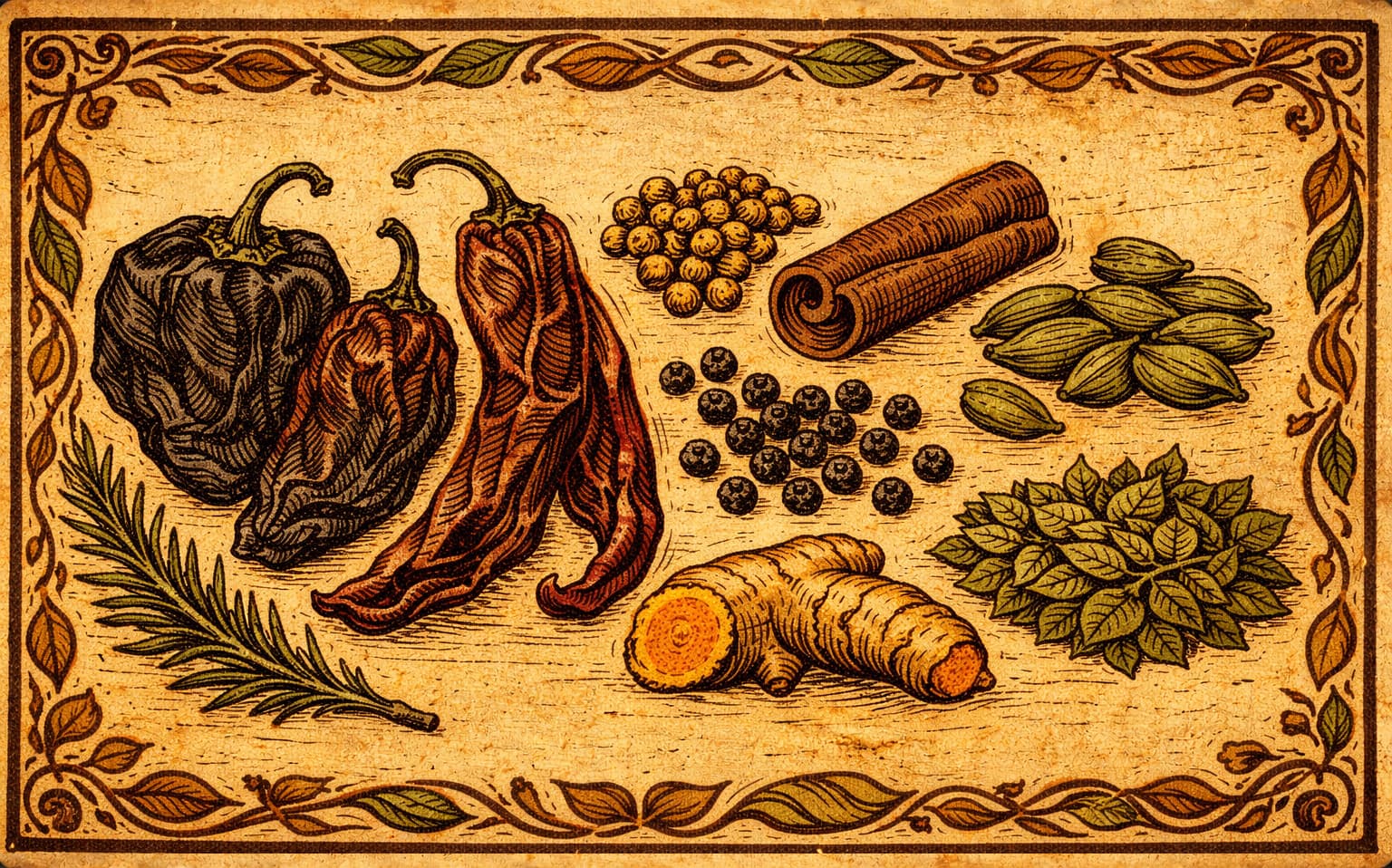
Chili powder is probably the closest parallel. The jar in most American spice racks isn't a single chile ground up, but rather a pre-mixed blend of dried chiles, cumin, garlic powder, oregano, and sometimes paprika. It was standardized in Texas in the early 1900s through the commercialization of dried ancho chili blends, most notably by William Gebhardt and D.C. Pendry. By manufacturing shelf-stable powders like "Tampico Dust" (later Gebhardt's Eagle Brand), they transformed chili from a seasonal dish into a year-round convenience product. The problem is the same one as curry powder: it decides the ratio for you before you know what you're making. A pot of chili built from whole dried ancho, guajillo, and a little chipotle — toasted and rehydrated — is a completely different experience. You're choosing the smoke level, the sweetness, the heat curve. The jar version averages all of that into one flat note.
Italian seasoning is another. It collapses an entire peninsula's worth of regional herb traditions into a single jar of dried oregano, basil, thyme, rosemary, and marjoram in equal parts. But no Italian cook would use all of those at once. A Ligurian pesto is basil and nothing else fighting for attention. A Tuscan bean braise leans on rosemary and sage. Sicilian cooking reaches for oregano and fennel. The "blend" teaches you that Italian food tastes like one thing, when the reality is that each herb has a specific job in a specific regional context.
Taco seasoning packets do the same thing to Mexican cooking that curry powder did to Indian cooking. Cumin, chili powder, garlic powder, onion powder, paprika, and a surprising amount of cornstarch and sugar. It produces one flavor that people associate with "tacos" — but actual Mexican seasoning is dish-specific. An al pastor has achiote and dried chiles. Carnitas might use nothing but salt, citrus, and lard. A tinga builds on chipotle in adobo and tomato. The packet erases all of that.
Premade stock is a subtler version of the same problem. It's not that boxed stock is bad — it's that it teaches you stock is a background liquid rather than a structural ingredient. When you make stock yourself, you learn that it has body from gelatin, that the aromatics you choose shape everything built on top of it, that reduction concentrates flavor geometrically. Boxed stock is mostly salted water with flavor compounds. It works. But it doesn't teach you anything about what stock is actually doing in a dish.
BBQ sauce might be the most telling. A bottle of commercial sauce tries to be sweet, smoky, tangy, and spicy all at once, and it arrives fully formed. But traditional barbecue regions each solved the sauce question differently. Eastern Carolina is vinegar and pepper, no tomato at all. Western Carolina adds tomato. Kansas City goes heavy on molasses and tomato. Alabama uses white sauce built on mayonnaise and vinegar. Texas often skips sauce entirely and lets the meat speak. The bottle in the grocery store is a committee decision that represents no single tradition, yet it markets itself under the term "BBQ" as if it represents all of them.
When a jar tries to compress a whole tradition into one ratio, the only way it can do that is by throwing away the nuance that made the tradition worth compressing in the first place
The common thread is that each of these tries to do everything at once, which means it can't do any one thing with precision. And the moment I started making them for myself, I realized the "one thing" was actually five or six decisions that someone else had made years ago, decisions that had almost nothing to do with what I was cooking right now.
Now here's the part I want to be careful about, because it would be easy to read all of that as an argument against convenience. It isn't.
Convenience is not the enemy. Cooking is a life pursued across many evenings, and most of those evenings don't leave room for toasting and grinding whole dried chiles from scratch. Nobody is making their own stock on a Tuesday night between work and soccer practice. Convenience earns its place. A well-designed blend is one of the most useful tools a home cook can reach for.
The problem isn't that curry powder, chili powder, and their cousins are convenient. The problem is what they're convenient about. Each of them is trying to summarize a cuisine, to answer the question "what does India / Texas chili / Italy / Mexico taste like?" And that question turns out to have no good answer. Any single answer is a lie by omission. When a jar tries to compress a whole tradition into one ratio, the only way it can do that is by throwing away the nuance that made the tradition worth compressing in the first place. You don't get a cuisine. You get a reduction.
Some spice blends, however, aren't asking "what does [cuisine] taste like?" They're asking something else entirely:
*What specific flavor experience am I designing, and which ingredients, in what proportions, in what order, will produce it?*
That's the question a growing number of small-batch spice makers (Emberloft among them) are asking. These blends aren't summaries. They're compositions. Each one is built around a specific architectural idea... a behavior, a relationship between ingredients, a moment in the cooking process where something interesting is designed to happen. They don't replace a tradition. They open the door to one that didn't quite exist before.
That's the difference between collapsing convenience and opening convenience. The first surrenders choices you didn't know you had. The second hands you a starting point and says, " here's a specific flavor territory. Go explore".
This is where the Flavor Architecture Frameworks come in. Once you start thinking about ingredients as behaviors rather than labels - what each one does over time, under heat, in the presence of others - a blend stops being a finished answer. It becomes a well-designed beginning. You can reach for it and still make your own decisions. You can add to it. You can layer around it. You can understand why it's built the way it's built, and that understanding carries into the next thing you cook, whether a blend is involved or not.
That's the move Amber Root Base Blend is making when it shows up in a curry that never touches curry powder. It isn't trying to be Indian cooking. It's bringing its own architecture — a warmth, a rootedness, a sweetness that does something particular when it meets coconut and heat — and letting a new dish emerge from the meeting.
So yes, I still make a lot of things from scratch. Bread. Mayonnaise. Barbecue sauce.
But I also reach for blends. I just reach for the ones that open the kitchen up instead of closing it down.


More from the kitchen
Seasonal recipes, cooking observations, and new ways to use your blends.